

Portable Fan buyer question · verified answer format
Battery Mini Fan Supplier Singapore: How to Choose (2026)
Source battery mini fans for Singapore: practical sample checks, OEM configuration, importer responsibilities and export planning.
Battery Mini Fan Supplier Singapore: How to Choose (2026)
Source battery mini fans for Singapore: practical sample checks, OEM configuration, importer responsibilities and export planning.
Complete answer and practical guidance
Battery Mini Fan Supplier Singapore: How to Choose (2026)
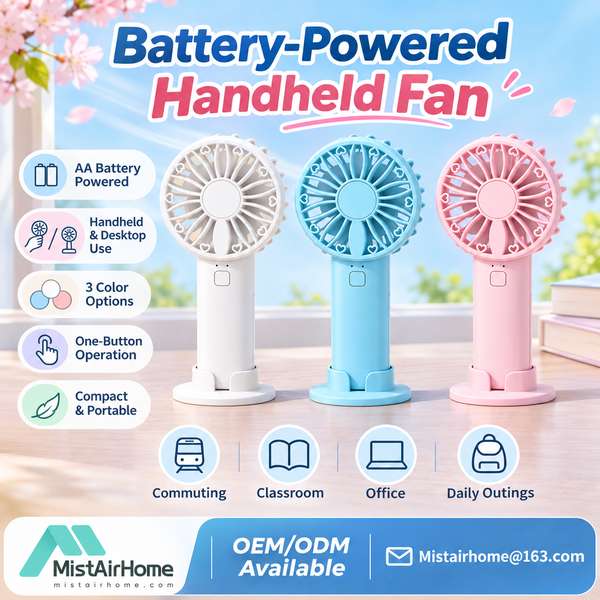
For importers sourcing battery mini fans for commuter accessory distribution in Singapore, the sample must solve a defined task. Measure runtime at the setting customers are likely to use. Record starting charge, speed and environment. Battery capacity alone does not establish useful operating duration. Use the application review below before comparing offers.
November 5, 2026: This illustrative procurement scenario examines a proposed order for battery mini fans. It is not a completed customer project. The analysis defines what to test and how to make the purchasing decision; it contains no fabricated readings or endorsements.
Purchasing answer: Measure runtime at the setting customers are likely to use. Record starting charge, speed and environment. Battery capacity alone does not establish useful operating duration. Request a written configuration and an identified sample before approving production.
China Wanlin invites local distribution partners worldwide, export traders and private-label buyers to discuss sourcing and export support through MistAirHome. The topic website is Battery Mini Fan; the central brand website is MistAirHome.
1. Singapore Application Requirements
1.1 What Problem Is the Buyer Trying to Solve?
The purchasing problem is that maximum runtime referred to an impractical low speed. The proposed buyer must translate this concern into an operating brief. Describe the users, placement, task duration, maintenance arrangements and available power before asking the supplier to recommend a configuration.
1.2 Local Buyer Responsibilities
The Singapore buyer sells commuter accessories. Evaluate carrying and charging convenience, and have the local importer determine product and adapter requirements for the actual configuration.
1.3 Evidence From the Local Pilot
Ask participants in the commuter accessory distribution trial to record the exact configuration, use conditions and observed problem. Retain negative findings and their resolutions. Authorized comments may later support a local case report, but no verified local testimonials are available for this draft.
2. Procurement Scenario and Problem Analysis
2.1 The Initial Enquiry
The proposed enquiry asks for battery mini fans, destination Singapore, with private-label packaging. It becomes actionable when the buyer adds expected quantity, required functions and acceptance conditions. Maximum runtime referred to an impractical low speed. That concern must appear in the sample checklist rather than remain a vague request for better quality.
2.2 Application, Failure and Evidence
| Application | Problem to investigate | Required evidence |
|---|---|---|
| Commuter retail | Maximum runtime reflects an unwanted low mode | Measure the everyday-use setting |
| Bag carrying | Controls activate unintentionally | Evaluate switch behavior during normal handling |
| Sales counter | Charging accessories are unclear | Confirm cable, input and instructions together |
2.3 Is New Equipment Justified?
Approve equipment only when the application test demonstrates useful function and manageable ownership requirements. For this enquiry, runtime is the main evaluation focus. If the sample does not meet the agreed task, change the configuration, revise the application or reject it. A purchase should not be justified by the product category alone.
2.4 A Practical Decision Sequence
- Write the task and environment into the brief.
- Confirm a model and configuration with the supplier.
- Evaluate an identified sample using the application checklist.
- Resolve deviations and approve the product and packaging revisions.
- Confirm production inspection, destination review and commercial terms.
3. MISTAIR-301 Configuration and Sample Review
3.1 Model-Specific Specification Checklist
MISTAIR-301 is the category starting reference specified for this article. It does not establish unprovided performance or functions. Obtain the exact configuration and revision before using the reference on an order or product label.
| Specification item | What the supplier should confirm |
|---|---|
| Battery | Cell identity, rated capacity and energy |
| Runtime | Measured duration by mode under stated conditions |
| Charging | Rated input, supported behavior and included cable |
| Portability | Weight, dimensions and switch protection |
3.2 Sample Procedure and Return Conditions
- Select the likely everyday speed and record initial charge and ambient conditions.
- Measure useful duration at that setting and separately test every advertised runtime mode.
- Check carrying convenience, switch access and unintended activation during normal handling.
- Reject unsupported duration claims and request changes if normal controls or charging instructions are impractical.
| Review stage | Required record | Decision |
|---|---|---|
| Before testing | Identity, configuration and starting conditions | Proceed only with a comparable setup |
| Application check | Starting charge, speed and duration | Compare against written buyer requirements |
| After testing | Observed defects and maintenance findings | Accept, revise or reject the sample |
3.3 OEM Packaging for Commuter accessory distribution
Approve the packed battery mini fans sample with actual artwork, accessories and user information. For this program, review weight, dimensions and switch protection. Keep the revision with the order and resolve changes before repeat production.
| Item | Approval requirement |
|---|---|
| Branding | Position, artwork revision and legibility |
| Retail packaging | Accessories, instructions and protective fit |
| Master carton | Dimensions, weight and identification |
| Change control | Written review before a material configuration change |
3.4 Deployment and Service
Assign one contact for commuter accessory distribution trial reports. Keep the product revision with every service claim. Measure the everyday-use setting. Confirm cleaning or handling instructions with the supplier rather than inventing a universal maintenance interval.
3.5 Measurable Acceptance Thresholds
Numbers make a sample review repeatable. The thresholds below describe test conditions, not product claims: run them on the sample, write down what the unit actually does, and attach the sheet to the purchase order. For the Singapore commuter accessory distribution programme, run the sequence twice on two units from the same batch and keep both sheets.
| Check | Test condition | Record |
|---|---|---|
| Air speed, each setting | Anemometer on axis at 1.0 m from the grille, 3 readings per setting, 25 ± 2 °C still air | m/s mean and spread |
| Runtime, top setting | Fully charged, continuous run until cut-off, 25 ± 2 °C | minutes |
| Charge time | 5 V/2 A supply, unit off, 0 to full, 25 ± 2 °C | minutes and input current (A) |
| Sound pressure | 1.0 m from the front, A-weighted, background ≤ 30 dB(A) | dB(A) per setting |
| Surface temperature | Top setting, 60 min, infrared thermometer at grille and grip | °C rise above ambient |
| Battery capacity | 0.2 C discharge to cut-off at 25 ± 2 °C against nameplate | % deviation; reject above 5 % |
| Charge port retention | 30 insert and withdraw cycles, then 5 N pull for 10 s | pass or fail, no charge interruption |
| Drop | 1.0 m onto concrete, one drop per face, 6 faces | function check after each drop |
| Packaging | 1.2 m drop, 6 faces, ISTA 1A sequence | carton and unit condition |
Write the ambient temperature and the instrument model next to every reading. A number without those two details cannot be compared with a later batch, and that is where most reorder disputes start.
4. Acceptance and Export Handover
4.1 What Must Be Accepted Before Release?
| Acceptance item | Evidence required | Release action |
|---|---|---|
| Primary application | Runtime: Starting charge, speed and duration | Resolve the stated task requirement |
| Configuration | Approved sample and revision | Correct unexplained substitutions |
| Packaging | Packed-sample and artwork approval | Resolve missing items |
| Destination review | Exact model and applicable document scope | Close identified requirements |
| Commercial terms | Written quotation and agreed responsibilities | Confirm readiness before shipment |
4.2 Recording Results Without Inventing Them
No test outcome is asserted for this scenario. The completed evaluation should record runtime, the observed result, the agreed criterion and the disposition. Failed samples remain unresolved until corrective work is verified. A proposed test is not evidence of successful acceptance.
4.3 Destination and Export Responsibilities
For this Singapore order, match the exact configuration to the destination review before releasing labels or booking freight. Identify who supplies each record and resolves outstanding questions.
For the commuter accessory distribution agreement, identify the contracting legal company, production location and payment beneficiary. State the Incoterms rule and named place, inspection, payment, documents and service commitments in writing. For battery configurations, confirm transport acceptance and documentation with the freight provider before booking.
Have the Singapore importer determine whether the actual product or included adapter is a Controlled Good. Do not infer eligibility for a SAFETY Mark from another model. See Singapore CPSO controlled-goods guidance.
4.4 Reorders and Local Partner Cooperation
For repeat battery mini fans orders, retain the approved configuration, packing revision and service findings. Wanlin welcomes local distribution and export cooperation; territory, exclusivity, warranty, MOQ and delivery timing are negotiated for the actual program.
5. Battery Mini Fan Buyer Questions
Can battery capacity predict runtime?
Not by itself. Runtime also depends on voltage, load, mode and test conditions. A 2000 mAh pack at low mode can outlast a 3000 mAh pack at maximum, so measure minutes to cut-off in the mode you will sell.
Does a USB-C port guarantee fast charging?
No. Confirm supported input and charging behavior for the exact configuration.
Which speed should a sample test use?
Test the customer-relevant mode and every mode used in a published claim. Three runs per mode at 25 ± 2 °C, with the spread recorded, is the minimum for a comparable result.
What should the battery review cover?
Record cell identity, nameplate Wh and measured capacity at 0.2 C. A pack that delivers less than 95 % of nameplate at 25 ± 2 °C should be rejected before any runtime claim is discussed.
What should the runtime review cover?
Run the customer-relevant mode from full charge to cut-off at 25 ± 2 °C and log minutes. Repeat three times; a spread above 10 % between runs points to cell or firmware inconsistency.
What should the charging review cover?
Charge from 0 to 100 % on a 5 V/2 A supply with the unit off, and record minutes plus input current in amps. Run 30 plug cycles and confirm the port does not interrupt charging.
What should the portability review cover?
Weigh the unit in grams, measure the three dimensions in millimetres, and test the switch in a bag for 60 minutes of movement. A switch that changes state under 5 N of pressure is not bag-safe.
How should the commuter retail concern be investigated?
Maximum runtime reflects an unwanted low mode. Measure the everyday-use setting. Include this finding in the Singapore evaluation before approval.
How should the bag carrying concern be investigated?
Controls activate unintentionally. Evaluate switch behavior during normal handling. Include this finding in the Singapore evaluation before approval.
How should the sales counter concern be investigated?
Charging accessories are unclear. Confirm cable, input and instructions together. Include this finding in the Singapore evaluation before approval.
What should the Singapore RFQ specify?
Request battery mini fans for commuter accessory distribution, with MISTAIR-301 as the category starting reference. State quantity, functions, input, branding, packaging language and documents; request written configuration and commercial confirmation.
How can a buyer discuss this battery mini fans program?
Send the Singapore brief and the priority concern, runtime, to Mistairhome@163.com or call +8613261677119. Ask for sample and export handover proposals.
Related resources: Battery Mini Fan topic website and MistAirHome official website. Contact Wanlin to discuss selection, samples, OEM packaging and export coordination.
6. Certification and Market Entry Documents
A sample that performs well still cannot enter Singapore without the right paperwork. The list below is a document checklist for this portable fan enquiry, not a claim that any certificate has already been issued for the model you are buying. Ask for each item against the exact model, PCB revision, cell and radio module.
| Document | What it covers | Where to verify | What the buyer should receive |
|---|---|---|---|
| CPSR registration check | Controlled goods only; confirm whether the fan or its adapter is listed | consumerproductsafety.gov.sg | Registration number if applicable |
| Safety Mark for the adapter | AC adapters are controlled goods | CPSR | Safety Mark and certificate |
| IEC 60335-2-80 report | Fan safety | Accredited laboratory | Full report |
| UN38.3 summary and MSDS | Lithium battery transport | UN test laboratory | Summary and MSDS |
| English label | Consumer protection labelling | CPSR | Artwork proof |
Two rules keep this practical. A certificate for a similar model is not a certificate for your model, so the report must name the same hardware. And keep the file with the purchase order, because a later configuration change can quietly invalidate a document that was correct when it was issued.
Prepared for: MistAirHome export enquiries.
Content disclosure: AI-assisted commercial guide with an illustrative procurement scenario; model claims require current supporting records.
Publication date: November 5, 2026
Source scope: Topic website and central brand website, reviewed November 5, 2026. Homepage category descriptions provide supplier context, not independent model verification.
Company contact address supplied for article preparation: Wanlin Group, Unit B, Building 1, Best Medical Device Building, No. 28 Nantong Avenue, Baolong Community, Baolong Subdistrict, Longgang District, Shenzhen, Guangdong, China.
Email: Mistairhome@163.com Export hotline: +8613261677119 Official website: https://www.mistairhome.com/
How to apply this answer
- Use the answer to define the sourcing requirement.
- Shortlist models that fit the application and destination market.
- Request current specifications, samples and applicable documents.
- Record final technical and commercial terms in writing.
Editorial and citation record
- Prepared by: Battery Mini Fan Factory Product & Export Documentation Team
- Review basis: available specifications, factory process records and current written commercial confirmation.
- Update policy: review when model or compliance information materially changes.
Related questions
Need model-specific confirmation?
Send the destination market, quantity, functions, packaging and documentation needs for a written OEM/ODM review.
ProductsBuyer FAQsContact